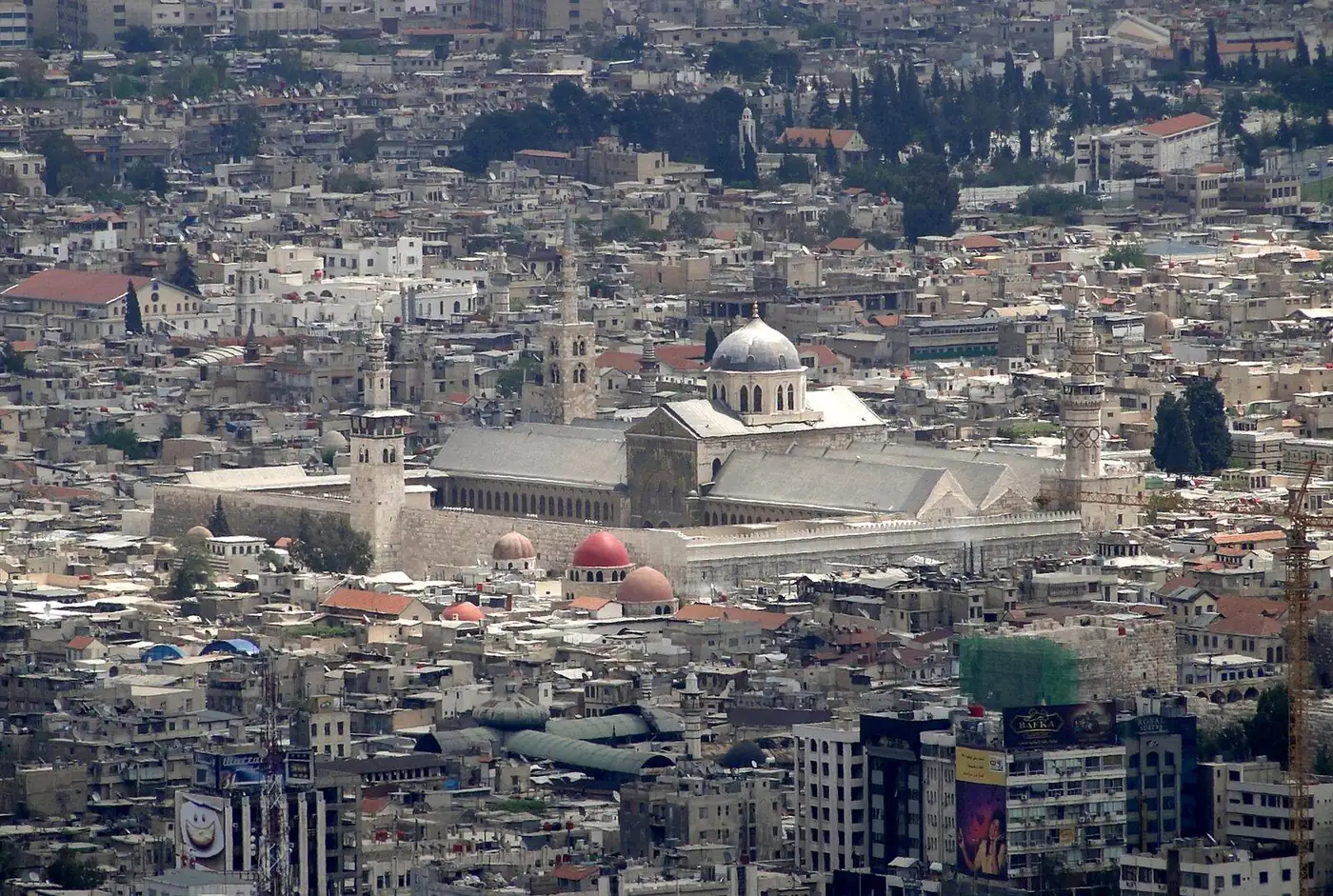
“The world's oldest continuously inhabited capital.”
- Province
- Damascus Governorate
- Population
- ~1.7 million
- Climate
- Hot, dry summers; cool winters with occasional snow on Mount Qasioun.
- Best Time
- March–May and September–November for mild, dry weather.
Today's weather — Damascus
Overview
History
Highlights
- Umayyad Mosque
- Al-Hamidiyeh Souq
- Straight Street (Via Recta)
- Azem Palace
- Bab Touma & Bab Sharqi
- Historic city walls
- National Museum of Damascus
- Mount Qasioun viewpoint
Major Attractions
Umayyad Mosque
Built 706–715 CE on the site of a Roman temple of Jupiter and a basilica of Saint John the Baptist. Famed for its glittering mosaic façade, three minarets, and the shrine said to hold the head of John the Baptist.
Al-Hamidiyeh Souq
A 600-metre covered Ottoman market roofed in corrugated iron pierced by sunlight from old bullet holes. Lined with spice merchants, brocade shops, and the legendary Bakdash ice-cream parlour.
Azem Palace
An 18th-century Damascene mansion built by governor As'ad Pasha al-Azem. The striated black-and-white stone courtyards, iwans, and inlaid wooden ceilings are now a museum of folk traditions.
Straight Street (Via Recta)
The Roman decumanus that runs east-west across the Old City, mentioned in the Acts of the Apostles. Still the main thoroughfare of the Christian and Jewish quarters.
Citadel of Damascus
A 13th-century Ayyubid fortress at the north-west corner of the Old City, built to anchor the medieval walls against Crusader and Mongol incursions.
Mount Qasioun
The mountain rising north of the city, with terraced cafés offering a panorama over Damascus at sunset and at night.
Tekkiye Mosque
A masterpiece of Ottoman classical architecture designed by the imperial architect Sinan in 1554, with twin minarets and a striped ablaq courtyard.
Traveller Tips
- Old City alleys are car-free and easy to walk — wear sturdy shoes for uneven stone paving.
- Carry small notes; many souq merchants and taxis cannot break large bills.
- Friday mornings are the quietest time in the souq; Saturday is the busiest.
- Dress modestly when visiting the Umayyad Mosque (abayas are provided at the women's entrance).
- Sunset on Mount Qasioun is spectacular but cold in winter — bring a jacket.
What to Eat
Fattoush
Crisp Levantine salad of toasted bread, sumac, purslane, and pomegranate molasses.
Shish Barak
Tiny meat dumplings simmered in warm yogurt sauce with garlic and dried mint.
Muhammara
Roasted red pepper and walnut dip sharpened with pomegranate molasses and Aleppo pepper.
Bakdash Ice Cream
Stretchy mastic-and-rosewater ice cream pounded with wooden mallets and rolled in pistachios.
Ma'amoul
Semolina shortbread stuffed with dates, walnuts, or pistachios — a Damascene Eid staple.
Other local flavours: Fattoush · Kibbeh · Shawarma · Muhammara · Ma'amoul
Where to Stay
Beit Al Mamlouka
Boutique heritage hotelRestored 17th-century courtyard house in the Christian quarter, regarded as the first boutique hotel in the Old City.
Talisman Hotel
Boutique heritage hotelOttoman-era mansion near Bab Sharqi with carved-wood ceilings and a small inner pool.
Dar Al Yasmin
GuesthouseAffordable family-run guesthouse inside a restored Damascene courtyard near the Umayyad Mosque.
Four Seasons Damascus
International luxuryModern five-star tower outside the Old City offering full Western-style amenities.