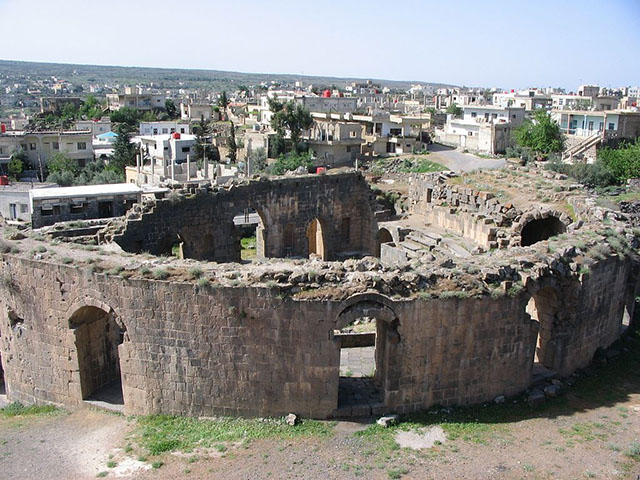
“The black basalt Roman city of Philippopolis, built by an Arab emperor.”
- Province
- As-Suwayda Governorate
- Population
- ~35,000
- Climate
- Highland Mediterranean: warm dry summers, cold winters with frost and occasional snow at 1,050 m.
- Best Time
- April–June and September–October; autumn coincides with the grape and apple harvest of Jabal al-Arab.
Today's weather — Shahba
Overview
History
Highlights
- Shahba Roman Theatre
- Shahba Museum mosaics
- The colonnaded cardo and decumanus
- Roman baths and gates
- Black basalt old town
- Jabal al-Arab orchards
Major Attractions
Shahba Theatre
A 3rd-century Roman theatre of black basalt facing the orchards and the mountain — one of the finest surviving theatres in Syria, still used for occasional festivals.
Shahba Museum
Built to house the town's mosaic floors, including the celebrated Orpheus charming the animals and a marine scene with Aphrodite — masterworks of late Roman mosaic art.
The colonnaded streets
The cardo and decumanus still cross at right angles, lined with fallen basalt columns and carved doorways of dark volcanic stone.
Roman baths
Monumental bath complexes from Philippopolis, their basalt vaulting and hypocaust systems still traceable among the houses of the modern town.
Jabal al-Arab
The green basalt massif rising behind the town — vineyards, apple orchards and Druze hill villages, with viewpoints over the whole plain.
Traveller Tips
- Combine with the National Museum mosaics and the nearby Roman site of Siah' and the temples of Qanawat, 20 km north-west.
- The museum keeps limited hours — check locally or arrive in the morning.
- Autumn is grape and apple season; roadside stalls sell fruit straight from the orchards.
- Dress modestly and ask before photographing people — this is the heart of the Druze community.
What to Eat
Jabal al-Arab grapes
The region's famous table grapes, raisins and thin-sheets of dried grape paste (keshk al-inab), sold at roadside stalls in late summer.
Mountain apples
Crisp autumn apples from the orchards around Shahba, a hallmark of the Suwayda highlands.
Home cooking
Meals in Shahba are home food — stuffed vine leaves, kibbeh, lentils and mountain dairy — best found in small local eateries and guesthouses.
Other local flavours: Grapes and raisins · Apples · Truffles from the steppe · Alkalama cheese and labneh
Where to Stay
Local guesthouses
GuesthouseA handful of family-run guesthouses in and around Shahba; book ahead in autumn.
As-Suwayda city
Base cityTwenty minutes south-west, with hotels, restaurants and the main market of the governorate.
Qanawat
Nearby baseAn attractive highland town 20 km away, beside its Roman temple ruins in the woods.